Analyse des Systemes Non Lineaires - Semestre 7
Annee Universitaire : 2023-2024
Semestre : 7
Credits : 2.5 ECTS
Specialite : Automatique et Systemes
PART A - Presentation Generale du Module
Vue d'ensemble
L'analyse des systemes non lineaires est une extension naturelle de l'automatique lineaire vers les systemes reels. Contrairement aux systemes lineaires, les systemes non lineaires peuvent exhiber des comportements complexes : points d'equilibre multiples, cycles limites, bifurcations, et meme chaos. Ce cours fournit les outils mathematiques pour analyser la stabilite et le comportement de ces systemes.
Objectifs pedagogiques :
- Comprendre les phenomenes non lineaires (saturation, hysteresis, cycles limites)
- Maitriser la theorie de stabilite de Lyapunov
- Analyser les systemes dans le plan de phase
- Appliquer la methode du premier harmonique (describing function)
- Etudier les bifurcations et le chaos
- Concevoir des lois de commande non lineaires
Position dans le cursus
Ce module s'appuie sur :
- Systemes multivariables (S7) : representation d'etat, stabilite
- Modelisation et commande des systemes lineaires (S5) : fonction de transfert, Bode, Nyquist
- Mathematiques : equations differentielles, analyse
Il prepare a :
- Commande avancee : commande robuste, adaptative
- Robotique : modelisation et commande de robots (systemes fortement non lineaires)
- Applications industrielles : regulation de processus, aerospatial
PART B - Experience Personnelle et Contexte d'Apprentissage
Organisation et ressources
Le module etait organise en cours magistraux et travaux diriges sur le semestre :
Cours magistraux (20h) :
Structure en 5 chapitres (chapitre1 a chapitre5) :
- Chapitre 1 : Introduction aux systemes non lineaires
- Chapitre 2 : Analyse dans le plan de phase
- Chapitre 3 : Stabilite au sens de Lyapunov
- Chapitre 4 : Methode du premier harmonique
- Chapitre 5 : Bifurcations et chaos
Travaux diriges (16h) :
9 seances de TD avec exercices d'application :
- TD1 a TD4 : plan de phase, points d'equilibre
- TD5 a TD7 : stabilite de Lyapunov
- TD8 et TD9 : methode du premier harmonique
Supports pedagogiques :
- Fascicules de cours (handout PDF)
- Enonces de TD (td1.pdf a td9.pdf)
- Simulations MATLAB/Simulink (simtd1.slx, simtd3.slx)
- Annales d'examens 2013, 2016, 2017, 2023 avec corriges
Methode de travail
Cours theorique :
Le cours est mathematiquement exigeant avec de nombreuses demonstrations. La comprehension des concepts (fonctions de Lyapunov, stabilite asymptotique) demande du temps et de la pratique.
TD et simulations :
Les TD permettent d'appliquer la theorie sur des exemples concrets (pendule, circuits electriques, systemes mecaniques). Les simulations Simulink visualisent les comportements non lineaires.
Annales :
Les annales de 2013 a 2023 avec corrections sont essentielles pour comprendre les attentes et le type d'exercices (analyse de stabilite, plan de phase, methode du premier harmonique).
Difficultes rencontrees
Abstraction mathematique :
La theorie de Lyapunov est puissante mais abstraite. Trouver une fonction de Lyapunov candidate pour prouver la stabilite n'est pas systematique et demande de l'intuition.
Visualisation des comportements :
Comprendre les portraits de phase (trajectoires dans l'espace d'etat) necessite une bonne visualisation geometrique.
Methode du premier harmonique :
La methode est basee sur des approximations (ne conserver que le premier harmonique). Comprendre ses limites et domaines de validite est important.
PART C - Aspects Techniques Detailles
1. Introduction aux systemes non lineaires
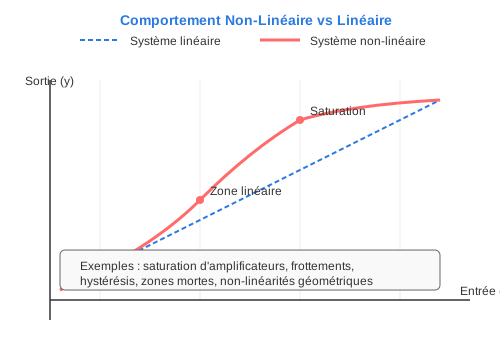
Figure : Comparaison entre systeme lineaire et non-lineaire - Phenomene de saturation
Definition :
Un systeme est non lineaire si son equation ne verifie pas le principe de superposition. Formellement, si :
- x1(t) → y1(t)
- x2(t) → y2(t)
Alors pour un systeme lineaire : a×x1(t) + b×x2(t) → a×y1(t) + b×y2(t)
Si cette propriete n'est pas verifiee, le systeme est non lineaire.
Exemples de non-linearites :
| Type | Equation | Exemples |
|---|---|---|
| Saturation | y = sat(u) | Actionneurs limites, amplificateurs |
| Zone morte | y = 0 si abs(u) < delta | Jeux mecaniques, seuils |
| Hysteresis | y depend de l'historique | Materiaux magnetiques, frottement |
| Multiplication | y = u1 × u2 | Modulation, puissance |
| Fonction trigonometrique | y = sin(u) | Pendule, robots |
| Puissance | y = u² ou u³ | Aerodynamique, hydraulique |
Consequences de la non-linearite :
- Points d'equilibre multiples : plusieurs etats stables possibles
- Cycles limites : oscillations auto-entretenues (independantes des conditions initiales)
- Phenomenes de saut : changement brutal de comportement
- Sous-harmoniques : frequences multiples dans la reponse
- Chaos : comportement imprevisible malgre un systeme deterministe
2. Modelisation des systemes non lineaires
Representation d'etat :
Forme generale d'un systeme non lineaire :
x point = f(x, u, t)
y = g(x, u, t)
ou x est le vecteur d'etat, u l'entree, y la sortie.
Systemes autonomes :
Si f ne depend pas explicitement du temps :
x point = f(x)
Exemple : pendule simple
Equation du mouvement :
theta point point + (g/L) sin(theta) = 0
Representation d'etat :
- x1 = theta (position angulaire)
- x2 = theta point (vitesse angulaire)
x1 point = x2
x2 point = -(g/L) sin(x1)
Points d'equilibre :
Solutions de f(x_eq) = 0
Pour le pendule :
- x_eq1 = (0, 0) : position basse (stable)
- x_eq2 = (pi, 0) : position haute (instable)
3. Analyse dans le plan de phase
Definition :
Pour un systeme du second ordre (2 variables d'etat), le plan de phase represente les trajectoires dans l'espace (x1, x2).
Portrait de phase :
Ensemble des trajectoires pour differentes conditions initiales. Permet de visualiser :
- Points d'equilibre
- Stabilite
- Bassins d'attraction
- Cycles limites
Classification des points d'equilibre :
Linearisation autour du point d'equilibre :
x point = A × x
ou A est la matrice jacobienne au point d'equilibre.
| Valeurs propres | Type | Stabilite |
|---|---|---|
| Reelles negatives | Noeud stable | Stable |
| Reelles positives | Noeud instable | Instable |
| Complexes Re < 0 | Foyer stable | Stable |
| Complexes Re > 0 | Foyer instable | Instable |
| Imaginaires pures | Centre | Marginalement stable |
| Opposees (± lambda) | Point selle | Instable |
Exemple : pendule amorti
theta point point + b theta point + (g/L) sin(theta) = 0
Avec amortissement b > 0 :
- Point (0, 0) : foyer stable (spirale convergeant vers l'origine)
- Point (pi, 0) : point selle (instable)
Separatrices :
Trajectoires qui separent differents bassins d'attraction. Pour le pendule, les separatrices partent du point selle.
4. Stabilite au sens de Lyapunov
Definition de la stabilite :
Un point d'equilibre x_eq est :
- Stable : si pour toute condition initiale proche, la trajectoire reste proche
- Asymptotiquement stable : stable + converge vers x_eq
- Instable : sinon
Theoreme de Lyapunov (methode directe) :
Soit V(x) une fonction scalaire (fonction de Lyapunov candidate) :
Conditions :
- V(x) > 0 pour tout x different de 0 (definie positive)
- V(0) = 0
- V point(x) <= 0 (derivee negative ou nulle)
Conclusion :
Si conditions 1, 2, 3 verifiees : point d'equilibre stable
Si en plus V point(x) < 0 (strictement negatif) : asymptotiquement stable
Interpretation :
V(x) peut etre vue comme une fonction d'energie generalisee. Si l'energie decroit (V point < 0), le systeme converge vers l'equilibre.
Exemple : systeme lineaire x point = A x
Fonction de Lyapunov candidate : V(x) = x^T P x (forme quadratique)
Derivee : V point = x^T (A^T P + P A) x
Pour que V point < 0, il faut : A^T P + P A = -Q avec Q > 0
Cette equation (equation de Lyapunov) a une solution P > 0 si et seulement si A est stable (valeurs propres a partie reelle negative).
Exemple : pendule avec frottement
Systeme :
x1 point = x2
x2 point = -(g/L) sin(x1) - b x2
Fonction de Lyapunov (energie totale) :
V(x1, x2) = (1/2) x2² + (g/L) (1 - cos(x1))
V(0, 0) = 0 et V(x1, x2) > 0 pour (x1, x2) different de (0, 0)
Derivee :
V point = x2 × x2 point + (g/L) sin(x1) × x1 point
V point = x2 × (-(g/L) sin(x1) - b x2) + (g/L) sin(x1) × x2
V point = -b x2²
V point <= 0 (negatif ou nul), donc le point (0, 0) est stable.
V point < 0 pour x2 different de 0, donc asymptotiquement stable.
Region de stabilite :
La region ou V(x) < c (constante) et V point < 0 est une estimation du bassin d'attraction.
Limitation :
Trouver une fonction de Lyapunov n'est pas systematique. Il n'y a pas de methode generale. L'ingenieur doit essayer differentes fonctions candidates (souvent basees sur l'energie physique du systeme).
5. Principe d'invariance de LaSalle
Extension du theoreme de Lyapunov :
Si V point <= 0 (et non strictement < 0), le theoreme de Lyapunov standard ne conclut que sur la stabilite, pas la convergence asymptotique.
Theoreme de LaSalle :
Si V point <= 0, le systeme converge vers le plus grand ensemble invariant contenu dans l'ensemble ou V point = 0.
Application :
Pour le pendule, V point = -b x2² = 0 seulement si x2 = 0.
L'ensemble ou V point = 0 est l'axe x1 (vitesse nulle).
Le seul ensemble invariant sur cet axe est le point (0, 0).
Donc le systeme converge vers (0, 0) : stabilite asymptotique.
6. Methode du premier harmonique (Describing Function)
Objectif :
Analyser les cycles limites (oscillations auto-entretenues) dans les systemes boucles comportant une non-linearite.
Principe :
Remplacer la non-linearite par un gain equivalent qui depend de l'amplitude de l'entree.
Systeme considere :
Boucle fermee : partie lineaire G(jw) + non-linearite N
Hypothese :
- Si l'entree de la non-linearite est sinusoidale : e(t) = A sin(wt)
- La sortie contient des harmoniques : s(t) = B1 sin(wt + phi1) + B2 sin(2wt + phi2) + ...
- Si G(jw) est passe-bas, les harmoniques superieurs sont attenues
- On ne conserve que le premier harmonique
Fonction de description :
N(A) = B1 / A × exp(j phi1)
Rapport complexe entre le premier harmonique de sortie et l'entree.
Exemples de fonctions de description :
| Non-linearite | N(A) |
|---|---|
| Gain lineaire k | k (constant) |
| Saturation | (2k/pi) [arcsin(M/A) + (M/A) sqrt(1 - (M/A)²)] |
| Zone morte | k [1 - (delta/A)] si A > delta |
| Relais ± M | (4M) / (pi A) |
| Hysteresis | Fonction complexe (dephasage) |
Condition d'existence d'un cycle limite :
Un cycle limite existe si :
1 + G(jw) × N(A) = 0
Ou : G(jw) = -1 / N(A)
Graphiquement :
Tracer G(jw) (Nyquist) et -1/N(A) dans le plan complexe.
Les intersections donnent les cycles limites possibles (frequence w et amplitude A).
Stabilite du cycle limite :
- Si -1/N(A) croise G(jw) de droite a gauche (en augmentant w) : cycle stable
- Si croisement de gauche a droite : cycle instable
Limitations :
- Valable si harmoniques superieurs negligeables
- Ne fonctionne pas pour toutes les non-linearites
- Resultats approximatifs
7. Linearisation par bouclage (Feedback Linearization)
Objectif :
Concevoir une loi de commande qui linearise exactement le systeme non lineaire.
Systeme non lineaire :
x point = f(x) + g(x) u
Commande linearisante :
u = (1/g(x)) [-f(x) + v]
ou v est une nouvelle entree.
Systeme en boucle fermee :
x point = v (systeme lineaire !)
On peut alors choisir v pour obtenir la dynamique desiree (placement de poles, LQR, etc.).
Exemple : pendule inverse
Equation : theta point point = (g/L) sin(theta) + u
Avec u = -(g/L) sin(theta) + v :
theta point point = v (double integrateur lineaire)
On peut alors stabiliser avec v = -k1 theta - k2 theta point (PD)
Limitations :
- Necessite la mesure ou estimation de tous les etats
- Modele exact du systeme requis
- Annulation de non-linearites peut amplifier les perturbations
- Pas toujours possible (conditions mathematiques a verifier)
8. Commande par modes glissants (Sliding Mode Control)
Principe :
Concevoir une surface de glissement s(x) = 0 sur laquelle le systeme a le comportement desire, puis forcer le systeme a rester sur cette surface.
Etapes :
- Definir la surface : s(x) = 0 (combinaison lineaire des etats)
- Loi de commande : u force s(x) a converger vers 0
- Mode glissant : une fois sur s(x) = 0, le systeme y reste
Exemple : systeme du 1er ordre
x point = f(x) + g(x) u
Surface : s(x) = x - x_desire
Commande : u = (1/g(x)) [-f(x) - k sign(s)]
avec k > 0 suffisamment grand.
Proprietes :
- Robustesse : insensible aux perturbations et incertitudes de modele
- Convergence en temps fini : atteint la surface en temps fini
- Chattering : oscillations haute frequence autour de la surface (probleme pratique)
Reduction du chattering :
Remplacer sign(s) par sat(s/epsilon) ou tanh(s/epsilon) pour lisser la commande.
9. Bifurcations
Definition :
Changement qualitatif du comportement d'un systeme quand un parametre varie.
Types de bifurcations :
Bifurcation selle-noeud :
- Apparition ou disparition de points d'equilibre
- Exemple : x point = r + x² (pour r < 0 : 2 equilibres, r = 0 : 1 equilibre, r > 0 : aucun)
Bifurcation transcritique :
- Echange de stabilite entre deux points d'equilibre
Bifurcation fourche (pitchfork) :
- Un point d'equilibre se divise en trois
- Symetrique ou asymetrique
Bifurcation de Hopf :
- Apparition d'un cycle limite a partir d'un point d'equilibre
- Exemple : oscillateur de Van der Pol
Diagramme de bifurcation :
Graphique representant les points d'equilibre (ou amplitudes de cycles) en fonction du parametre.
10. Introduction au chaos
Definition :
Comportement aperiodique deterministe sensible aux conditions initiales.
Caracteristiques :
- Deterministe : pas de hasard, equations precises
- Aperiodique : ne se repete jamais exactement
- Sensibilite aux conditions initiales : deux trajectoires proches divergent exponentiellement (effet papillon)
Exposants de Lyapunov :
Mesurent le taux moyen de divergence ou convergence des trajectoires.
- Exposant > 0 : divergence (chaos)
- Exposant < 0 : convergence (stabilite)
- Exposant = 0 : comportement marginal
Exemples de systemes chaotiques :
Systeme de Lorenz :
x point = sigma (y - x)
y point = r x - y - x z
z point = x y - b z
Pour certaines valeurs de parametres (r = 28, sigma = 10, b = 8/3) : comportement chaotique (attracteur etrange).
Attracteur de Lorenz :
Structure geometrique en forme de papillon dans l'espace de phase. Les trajectoires tournent autour de deux lobes sans jamais se repeter.
Route vers le chaos :
Cascade de doublement de periode : oscillation de periode T → 2T → 4T → 8T → ... → chaos
Carte de Poincare :
Reduction d'un systeme continu par echantillonnage (intersection avec une surface). Facilite l'analyse du chaos.
11. Applications pratiques
Pendule inverse :
Systeme instable en boucle ouverte. Linearisation par bouclage ou commande par modes glissants pour stabilisation.
Oscillateur de Van der Pol :
x point point - mu (1 - x²) x point + x = 0
Pour mu > 0 : cycle limite (oscillation auto-entretenue). Exemple de systeme presentant une bifurcation de Hopf.
Circuit de Chua :
Circuit electronique simple exhibant du chaos. Utilise pour etudier les systemes chaotiques en laboratoire.
Systeme proie-predateur (Lotka-Volterra) :
x point = a x - b x y (proies)
y point = -c y + d x y (predateurs)
Modele biologique avec cycles (oscillations des populations).
PART D - Analyse Reflexive et Perspectives
Competences acquises
Analyse de stabilite :
Maitrise de la theorie de Lyapunov pour prouver rigoureusement la stabilite de systemes non lineaires. Capacite a construire des fonctions de Lyapunov candidates.
Visualisation geometrique :
Comprehension des portraits de phase et trajectoires dans l'espace d'etat. Identification des points d'equilibre et de leur nature (noeud, foyer, selle).
Analyse frequentielle :
Application de la methode du premier harmonique pour predire l'existence de cycles limites dans les systemes boucles.
Points cles a retenir
1. Non-linearite = richesse comportementale :
Les systemes non lineaires peuvent avoir des comportements tres varies (multistabilite, cycles limites, chaos) que les systemes lineaires ne peuvent pas exhiber.
2. Lyapunov = outil fondamental :
La theorie de Lyapunov est la methode principale pour prouver la stabilite. L'energie du systeme est souvent une bonne fonction de Lyapunov candidate.
3. Linearisation locale vs globale :
L'analyse lineaire locale (jacobienne) donne des informations pres des equilibres mais ne capture pas le comportement global.
4. Methode du premier harmonique = approximation :
Utile pour analyser rapidement les cycles limites mais resultats approximatifs.
5. Chaos = deterministe mais imprevisible :
Le chaos montre qu'un systeme simple et deterministe peut etre imprevisible a long terme. Importance de la sensibilite aux conditions initiales.
Applications pratiques
Robotique :
Les robots sont des systemes fortement non lineaires (couplages, frottements, gravite). Les methodes de linearisation par bouclage sont couramment utilisees.
Aerospatial :
Controle d'attitude des satellites et avions (non-linearites angulaires). Analyse de stabilite critique pour la securite.
Processus industriels :
Regulation de temperature, pression, debit avec actionneurs satures. Analyse de stabilite et anti-windup.
Electronique de puissance :
Convertisseurs DC-DC avec commutations (non-linearites par morceaux). Commande par modes glissants frequemment employee.
Retour d'experience
Cours exigeant :
Le niveau mathematique est eleve. Les demonstrations de theoremes (Lyapunov, LaSalle) demandent rigueur et abstraction.
TD essentiels :
Les 9 TD permettent de s'approprier les concepts sur des exemples concrets. Les simulations Simulink aident a visualiser les comportements.
Annales precieuses :
Les annales de 2013 a 2023 montrent les types d'exercices (analyse de stabilite, plan de phase, methode harmonique). Les corrections detaillees sont tres utiles.
Fascination pour le chaos :
Decouvrir que des systemes simples (3 equations) peuvent generer du chaos est marquant. Le paradoxe determinisme/imprevisibilite est philosophiquement interessant.
Limites et ouvertures
Limites du module :
- Peu de TP pratiques (surtout theorique)
- Commande adaptative et robuste non traitees en detail
- Systemes hybrides (continus + discrets) non abordes
Ouvertures vers :
- Commande robuste H-infini : prise en compte d'incertitudes
- Commande adaptative : systemes avec parametres inconnus ou variants
- Observation non lineaire : estimation d'etats pour systemes non lineaires
- Systemes hybrides : melange dynamiques continues et discretes
- Machine learning pour la commande : apprentissage de lois de commande non lineaires
Conseils pour reussir
1. Travailler les TD :
Refaire les 9 TD sans regarder les corrections. Les exercices couvrent tous les aspects du cours.
2. Visualiser avec MATLAB :
Utiliser les simulations Simulink fournies (simtd1, simtd3) et creer ses propres simulations pour explorer les comportements.
3. S'entrainer sur les annales :
Les examens de 2013 a 2023 montrent le format attendu. Bien comprendre les corrections.
4. Maitriser Lyapunov :
C'est le coeur du cours. Pratiquer la construction de fonctions de Lyapunov sur differents systemes.
5. Comprendre les limites :
Chaque methode a ses hypotheses et limites. Savoir quand elle s'applique et quand elle echoue.
Conclusion
L'analyse des systemes non lineaires est un domaine fascinant et essentiel pour l'ingenieur automaticien. Les systemes reels sont presque toujours non lineaires, et savoir analyser leur comportement est crucial.
Philosophie du cours :
Passer du monde idealise (lineaire) au monde reel (non lineaire). Accepter la complexite et developper des outils pour la maitriser.
Competences transferables :
- Rigueur mathematique dans l'analyse
- Pensee geometrique (espace d'etat, trajectoires)
- Intuition physique (energie, stabilite)
- Capacite a gerer la complexite
Message principal :
Les systemes non lineaires ne sont pas des versions compliquees de systemes lineaires. Ils ont leur propre richesse comportementale. Les comprendre ouvre la porte a l'analyse de systemes reels complexes.
Recommandations :
- Approfondir avec des simulations (MATLAB, Python)
- Lire des articles sur applications (robotique, aerospatial)
- Explorer les liens avec la theorie du chaos et systemes dynamiques
- Se former a la commande non lineaire avancee (backstepping, modes glissants d'ordre superieur)
Liens avec les autres cours :
- Systemes multivariables - S7 : representation d'etat, stabilite
- Commande Numerique - S8 : implementation discrete
- Programmation Orientee Objets C++ - S7 : simulations numeriques
Cours suivi en 2023-2024 a l'INSA Toulouse, Departement Genie Electrique et Informatique.
Nonlinear Systems Analysis - Semester 7
Academic Year: 2023-2024
Semester: 7
Credits: 2.5 ECTS
Specialization: Control Systems and Automation
PART A - General Module Overview
Overview
Nonlinear systems analysis is a natural extension of linear control theory toward real-world systems. Unlike linear systems, nonlinear systems can exhibit complex behaviors: multiple equilibrium points, limit cycles, bifurcations, and even chaos. This course provides the mathematical tools to analyze the stability and behavior of these systems.
Learning objectives:
- Understand nonlinear phenomena (saturation, hysteresis, limit cycles)
- Master Lyapunov stability theory
- Analyze systems in the phase plane
- Apply the describing function method
- Study bifurcations and chaos
- Design nonlinear control laws
Position in the curriculum
This module builds upon:
- Multivariable Systems (S7): state-space representation, stability
- Linear Systems Modeling and Control (S5): transfer function, Bode, Nyquist
- Mathematics: differential equations, analysis
It prepares for:
- Advanced control: robust control, adaptive control
- Robotics: modeling and control of robots (highly nonlinear systems)
- Industrial applications: process control, aerospace
PART B - Personal Experience and Learning Context
Organization and resources
The module was organized into lectures and tutorials over the semester:
Lectures (20h):
Structured in 5 chapters (chapter 1 to chapter 5):
- Chapter 1: Introduction to nonlinear systems
- Chapter 2: Phase plane analysis
- Chapter 3: Lyapunov stability
- Chapter 4: Describing function method
- Chapter 5: Bifurcations and chaos
Tutorials (16h):
9 tutorial sessions with application exercises:
- TD1 to TD4: phase plane, equilibrium points
- TD5 to TD7: Lyapunov stability
- TD8 and TD9: describing function method
Teaching materials:
- Course handouts (handout PDF)
- Tutorial problem sets (td1.pdf to td9.pdf)
- MATLAB/Simulink simulations (simtd1.slx, simtd3.slx)
- Past exams from 2013, 2016, 2017, 2023 with solutions
Working method
Theoretical lectures:
The course is mathematically demanding with numerous proofs. Understanding the concepts (Lyapunov functions, asymptotic stability) requires time and practice.
Tutorials and simulations:
The tutorials allow applying theory to concrete examples (pendulum, electrical circuits, mechanical systems). Simulink simulations visualize nonlinear behaviors.
Past exams:
Past exams from 2013 to 2023 with solutions are essential for understanding expectations and the types of exercises (stability analysis, phase plane, describing function method).
Difficulties encountered
Mathematical abstraction:
Lyapunov theory is powerful but abstract. Finding a candidate Lyapunov function to prove stability is not systematic and requires intuition.
Behavior visualization:
Understanding phase portraits (trajectories in state space) requires good geometric visualization.
Describing function method:
The method is based on approximations (retaining only the first harmonic). Understanding its limitations and domains of validity is important.
PART C - Detailed Technical Aspects
1. Introduction to nonlinear systems
Figure: Comparison between linear and nonlinear systems - Saturation phenomenon
Definition:
A system is nonlinear if its equation does not satisfy the superposition principle. Formally, if:
- x1(t) → y1(t)
- x2(t) → y2(t)
Then for a linear system: a×x1(t) + b×x2(t) → a×y1(t) + b×y2(t)
If this property is not satisfied, the system is nonlinear.
Examples of nonlinearities:
| Type | Equation | Examples |
|---|---|---|
| Saturation | y = sat(u) | Limited actuators, amplifiers |
| Dead zone | y = 0 if abs(u) < delta | Mechanical play, thresholds |
| Hysteresis | y depends on history | Magnetic materials, friction |
| Multiplication | y = u1 × u2 | Modulation, power |
| Trigonometric function | y = sin(u) | Pendulum, robots |
| Power | y = u² or u³ | Aerodynamics, hydraulics |
Consequences of nonlinearity:
- Multiple equilibrium points: several possible stable states
- Limit cycles: self-sustained oscillations (independent of initial conditions)
- Jump phenomena: abrupt behavior changes
- Subharmonics: multiple frequencies in the response
- Chaos: unpredictable behavior despite a deterministic system
2. Modeling of nonlinear systems
State-space representation:
General form of a nonlinear system:
x dot = f(x, u, t)
y = g(x, u, t)
where x is the state vector, u the input, y the output.
Autonomous systems:
If f does not explicitly depend on time:
x dot = f(x)
Example: simple pendulum
Equation of motion:
theta double dot + (g/L) sin(theta) = 0
State-space representation:
- x1 = theta (angular position)
- x2 = theta dot (angular velocity)
x1 dot = x2
x2 dot = -(g/L) sin(x1)
Equilibrium points:
Solutions of f(x_eq) = 0
For the pendulum:
- x_eq1 = (0, 0): lower position (stable)
- x_eq2 = (pi, 0): upper position (unstable)
3. Phase plane analysis
Definition:
For a second-order system (2 state variables), the phase plane represents trajectories in the (x1, x2) space.
Phase portrait:
Set of trajectories for different initial conditions. Allows visualization of:
- Equilibrium points
- Stability
- Basins of attraction
- Limit cycles
Classification of equilibrium points:
Linearization around the equilibrium point:
x dot = A × x
where A is the Jacobian matrix at the equilibrium point.
| Eigenvalues | Type | Stability |
|---|---|---|
| Real negative | Stable node | Stable |
| Real positive | Unstable node | Unstable |
| Complex Re < 0 | Stable focus | Stable |
| Complex Re > 0 | Unstable focus | Unstable |
| Pure imaginary | Center | Marginally stable |
| Opposite (± lambda) | Saddle point | Unstable |
Example: damped pendulum
theta double dot + b theta dot + (g/L) sin(theta) = 0
With damping b > 0:
- Point (0, 0): stable focus (spiral converging toward the origin)
- Point (pi, 0): saddle point (unstable)
Separatrices:
Trajectories that separate different basins of attraction. For the pendulum, the separatrices originate from the saddle point.
4. Lyapunov stability
Definition of stability:
An equilibrium point x_eq is:
- Stable: if for any nearby initial condition, the trajectory remains close
- Asymptotically stable: stable + converges to x_eq
- Unstable: otherwise
Lyapunov theorem (direct method):
Let V(x) be a scalar function (candidate Lyapunov function):
Conditions:
- V(x) > 0 for all x different from 0 (positive definite)
- V(0) = 0
- V dot(x) <= 0 (negative or zero derivative)
Conclusion:
If conditions 1, 2, 3 are satisfied: equilibrium point is stable
If additionally V dot(x) < 0 (strictly negative): asymptotically stable
Interpretation:
V(x) can be seen as a generalized energy function. If the energy decreases (V dot < 0), the system converges to equilibrium.
Example: linear system x dot = A x
Candidate Lyapunov function: V(x) = x^T P x (quadratic form)
Derivative: V dot = x^T (A^T P + P A) x
For V dot < 0, we need: A^T P + P A = -Q with Q > 0
This equation (Lyapunov equation) has a solution P > 0 if and only if A is stable (eigenvalues with negative real part).
Example: pendulum with friction
System:
x1 dot = x2
x2 dot = -(g/L) sin(x1) - b x2
Lyapunov function (total energy):
V(x1, x2) = (1/2) x2² + (g/L) (1 - cos(x1))
V(0, 0) = 0 and V(x1, x2) > 0 for (x1, x2) different from (0, 0)
Derivative:
V dot = x2 × x2 dot + (g/L) sin(x1) × x1 dot
V dot = x2 × (-(g/L) sin(x1) - b x2) + (g/L) sin(x1) × x2
V dot = -b x2²
V dot <= 0 (negative or zero), so the point (0, 0) is stable.
V dot < 0 for x2 different from 0, so asymptotically stable.
Stability region:
The region where V(x) < c (constant) and V dot < 0 is an estimate of the basin of attraction.
Limitation:
Finding a Lyapunov function is not systematic. There is no general method. The engineer must try different candidate functions (often based on the physical energy of the system).
5. LaSalle's invariance principle
Extension of the Lyapunov theorem:
If V dot <= 0 (and not strictly < 0), the standard Lyapunov theorem only concludes on stability, not asymptotic convergence.
LaSalle's theorem:
If V dot <= 0, the system converges to the largest invariant set contained in the set where V dot = 0.
Application:
For the pendulum, V dot = -b x2² = 0 only if x2 = 0.
The set where V dot = 0 is the x1 axis (zero velocity).
The only invariant set on this axis is the point (0, 0).
Therefore the system converges to (0, 0): asymptotic stability.
6. Describing function method
Objective:
Analyze limit cycles (self-sustained oscillations) in feedback systems containing a nonlinearity.
Principle:
Replace the nonlinearity with an equivalent gain that depends on the input amplitude.
System considered:
Closed loop: linear part G(jw) + nonlinearity N
Hypothesis:
- If the nonlinearity input is sinusoidal: e(t) = A sin(wt)
- The output contains harmonics: s(t) = B1 sin(wt + phi1) + B2 sin(2wt + phi2) + ...
- If G(jw) is low-pass, higher harmonics are attenuated
- Only the first harmonic is retained
Describing function:
N(A) = B1 / A × exp(j phi1)
Complex ratio between the first harmonic of the output and the input.
Examples of describing functions:
| Nonlinearity | N(A) |
|---|---|
| Linear gain k | k (constant) |
| Saturation | (2k/pi) [arcsin(M/A) + (M/A) sqrt(1 - (M/A)²)] |
| Dead zone | k [1 - (delta/A)] if A > delta |
| Relay ± M | (4M) / (pi A) |
| Hysteresis | Complex function (phase shift) |
Condition for limit cycle existence:
A limit cycle exists if:
1 + G(jw) × N(A) = 0
Or: G(jw) = -1 / N(A)
Graphically:
Plot G(jw) (Nyquist) and -1/N(A) in the complex plane.
Intersections give the possible limit cycles (frequency w and amplitude A).
Limit cycle stability:
- If -1/N(A) crosses G(jw) from right to left (as w increases): stable cycle
- If crossing from left to right: unstable cycle
Limitations:
- Valid if higher harmonics are negligible
- Does not work for all nonlinearities
- Approximate results
7. Feedback linearization
Objective:
Design a control law that exactly linearizes the nonlinear system.
Nonlinear system:
x dot = f(x) + g(x) u
Linearizing control:
u = (1/g(x)) [-f(x) + v]
where v is a new input.
Closed-loop system:
x dot = v (linear system!)
One can then choose v to obtain the desired dynamics (pole placement, LQR, etc.).
Example: inverted pendulum
Equation: theta double dot = (g/L) sin(theta) + u
With u = -(g/L) sin(theta) + v:
theta double dot = v (linear double integrator)
Stabilization can then be achieved with v = -k1 theta - k2 theta dot (PD)
Limitations:
- Requires measurement or estimation of all states
- Exact system model required
- Cancellation of nonlinearities may amplify disturbances
- Not always possible (mathematical conditions to verify)
8. Sliding mode control
Principle:
Design a sliding surface s(x) = 0 on which the system has the desired behavior, then force the system to stay on this surface.
Steps:
- Define the surface: s(x) = 0 (linear combination of states)
- Control law: u forces s(x) to converge to 0
- Sliding mode: once on s(x) = 0, the system remains there
Example: first-order system
x dot = f(x) + g(x) u
Surface: s(x) = x - x_desired
Control: u = (1/g(x)) [-f(x) - k sign(s)]
with k > 0 sufficiently large.
Properties:
- Robustness: insensitive to disturbances and model uncertainties
- Finite-time convergence: reaches the surface in finite time
- Chattering: high-frequency oscillations around the surface (practical issue)
Chattering reduction:
Replace sign(s) with sat(s/epsilon) or tanh(s/epsilon) to smooth the control.
9. Bifurcations
Definition:
Qualitative change in a system's behavior when a parameter varies.
Types of bifurcations:
Saddle-node bifurcation:
- Appearance or disappearance of equilibrium points
- Example: x dot = r + x² (for r < 0: 2 equilibria, r = 0: 1 equilibrium, r > 0: none)
Transcritical bifurcation:
- Exchange of stability between two equilibrium points
Pitchfork bifurcation:
- One equilibrium point splits into three
- Symmetric or asymmetric
Hopf bifurcation:
- Emergence of a limit cycle from an equilibrium point
- Example: Van der Pol oscillator
Bifurcation diagram:
Graph showing equilibrium points (or cycle amplitudes) as a function of the parameter.
10. Introduction to chaos
Definition:
Aperiodic deterministic behavior sensitive to initial conditions.
Characteristics:
- Deterministic: no randomness, precise equations
- Aperiodic: never repeats exactly
- Sensitivity to initial conditions: two nearby trajectories diverge exponentially (butterfly effect)
Lyapunov exponents:
Measure the average rate of divergence or convergence of trajectories.
- Exponent > 0: divergence (chaos)
- Exponent < 0: convergence (stability)
- Exponent = 0: marginal behavior
Examples of chaotic systems:
Lorenz system:
x dot = sigma (y - x)
y dot = r x - y - x z
z dot = x y - b z
For certain parameter values (r = 28, sigma = 10, b = 8/3): chaotic behavior (strange attractor).
Lorenz attractor:
Butterfly-shaped geometric structure in phase space. Trajectories revolve around two lobes without ever repeating.
Route to chaos:
Period-doubling cascade: oscillation with period T → 2T → 4T → 8T → ... → chaos
Poincare map:
Reduction of a continuous system through sampling (intersection with a surface). Facilitates chaos analysis.
11. Practical applications
Inverted pendulum:
Open-loop unstable system. Feedback linearization or sliding mode control for stabilization.
Van der Pol oscillator:
x double dot - mu (1 - x²) x dot + x = 0
For mu > 0: limit cycle (self-sustained oscillation). Example of a system exhibiting a Hopf bifurcation.
Chua's circuit:
Simple electronic circuit exhibiting chaos. Used to study chaotic systems in the laboratory.
Predator-prey system (Lotka-Volterra):
x dot = a x - b x y (prey)
y dot = -c y + d x y (predators)
Biological model with cycles (population oscillations).
PART D - Reflective Analysis and Perspectives
Skills acquired
Stability analysis:
Mastery of Lyapunov theory for rigorously proving the stability of nonlinear systems. Ability to construct candidate Lyapunov functions.
Geometric visualization:
Understanding of phase portraits and trajectories in state space. Identification of equilibrium points and their nature (node, focus, saddle).
Frequency analysis:
Application of the describing function method to predict the existence of limit cycles in feedback systems.
Key takeaways
1. Nonlinearity = behavioral richness:
Nonlinear systems can exhibit highly varied behaviors (multistability, limit cycles, chaos) that linear systems cannot.
2. Lyapunov = fundamental tool:
Lyapunov theory is the main method for proving stability. The system's energy is often a good candidate Lyapunov function.
3. Local vs global linearization:
Local linear analysis (Jacobian) provides information near equilibria but does not capture global behavior.
4. Describing function method = approximation:
Useful for quickly analyzing limit cycles but yields approximate results.
5. Chaos = deterministic but unpredictable:
Chaos shows that a simple, deterministic system can be unpredictable in the long term. Importance of sensitivity to initial conditions.
Practical applications
Robotics:
Robots are highly nonlinear systems (couplings, friction, gravity). Feedback linearization methods are commonly used.
Aerospace:
Attitude control of satellites and aircraft (angular nonlinearities). Critical stability analysis for safety.
Industrial processes:
Temperature, pressure, and flow regulation with saturated actuators. Stability analysis and anti-windup.
Power electronics:
DC-DC converters with switching (piecewise nonlinearities). Sliding mode control is frequently employed.
Feedback on experience
Demanding course:
The mathematical level is high. Theorem proofs (Lyapunov, LaSalle) require rigor and abstraction.
Essential tutorials:
The 9 tutorials allow appropriating the concepts through concrete examples. Simulink simulations help visualize behaviors.
Valuable past exams:
Past exams from 2013 to 2023 show the types of exercises (stability analysis, phase plane, harmonic method). Detailed solutions are very useful.
Fascination with chaos:
Discovering that simple systems (3 equations) can generate chaos is striking. The determinism/unpredictability paradox is philosophically interesting.
Limitations and perspectives
Module limitations:
- Few practical labs (mostly theoretical)
- Adaptive and robust control not covered in detail
- Hybrid systems (continuous + discrete) not addressed
Perspectives toward:
- H-infinity robust control: accounting for uncertainties
- Adaptive control: systems with unknown or varying parameters
- Nonlinear observation: state estimation for nonlinear systems
- Hybrid systems: mix of continuous and discrete dynamics
- Machine learning for control: learning nonlinear control laws
Tips for success
1. Work through the tutorials:
Redo all 9 tutorials without looking at the solutions. The exercises cover all aspects of the course.
2. Visualize with MATLAB:
Use the provided Simulink simulations (simtd1, simtd3) and create your own simulations to explore behaviors.
3. Practice with past exams:
Exams from 2013 to 2023 show the expected format. Thoroughly understand the solutions.
4. Master Lyapunov:
This is the core of the course. Practice constructing Lyapunov functions for different systems.
5. Understand the limitations:
Each method has its assumptions and limitations. Know when it applies and when it fails.
Conclusion
Nonlinear systems analysis is a fascinating and essential field for the control engineer. Real systems are almost always nonlinear, and knowing how to analyze their behavior is crucial.
Course philosophy:
Moving from the idealized world (linear) to the real world (nonlinear). Accepting complexity and developing tools to master it.
Transferable skills:
- Mathematical rigor in analysis
- Geometric thinking (state space, trajectories)
- Physical intuition (energy, stability)
- Ability to manage complexity
Main message:
Nonlinear systems are not complicated versions of linear systems. They have their own behavioral richness. Understanding them opens the door to the analysis of complex real-world systems.
Recommendations:
- Deepen knowledge with simulations (MATLAB, Python)
- Read articles on applications (robotics, aerospace)
- Explore connections with chaos theory and dynamical systems
- Train in advanced nonlinear control (backstepping, higher-order sliding modes)
Links to other courses:
- Multivariable Systems - S7: state-space representation, stability
- Digital Control - S8: discrete implementation
- Object-Oriented Programming C++ - S7: numerical simulations
Course taken in 2023-2024 at INSA Toulouse, Department of Electrical and Computer Engineering.
Chapitre 1 - IntroductionChapter 1 - Introduction
Introduction aux systemes non lineaires : exemples, limites des approches lineaires et presentation des outils d'analyse.Introduction to nonlinear systems: examples, limitations of linear approaches, and overview of analysis tools.
Chapitre 2 - Plans de PhaseChapter 2 - Phase Planes
Methode du plan de phase : points d'equilibre, trajectoires, portrait de phase et analyse geometrique de la stabilite.Phase plane method: equilibrium points, trajectories, phase portrait, and geometric stability analysis.
Chapitre 3 - Methode de LyapunovChapter 3 - Lyapunov Method
Theorie de Lyapunov : fonctions de Lyapunov, criteres de stabilite et methode directe pour l'analyse de stabilite.Lyapunov theory: Lyapunov functions, stability criteria, and the direct method for stability analysis.
Annales 20232023 Past Exam
Sujet d'examen 2023 avec exercices sur la stabilite, methode de Lyapunov et cycles limites.2023 exam paper with exercises on stability, Lyapunov method, and limit cycles.